Notes in seminar—Summar School 2025
Seminar information
Organisation
School of Life Science, Fudan University
Modules
Genetics and Developmental Biology
Evolutionary and Biological Big Data
Calendar
Module 1
Time Morning Afternoon July 23 / Wed Duanqing Pei Icebreaker activity July 24 / Thu Vivek Malhotra Xiangdong Fu July 25 / Fri Jerry Workman Kun-Liang Guan July 26 / Sat Tak Wah Mak Don Cleveland July 28 / Mon Bing Zhu Jonathan Kipnis July 29 / Tue Jin Billy Li Visiting activities July 30 / Wed Yungui Yang Guanghui Liu July 31 / Thu Mini-symposium Mini-symposium Module 2
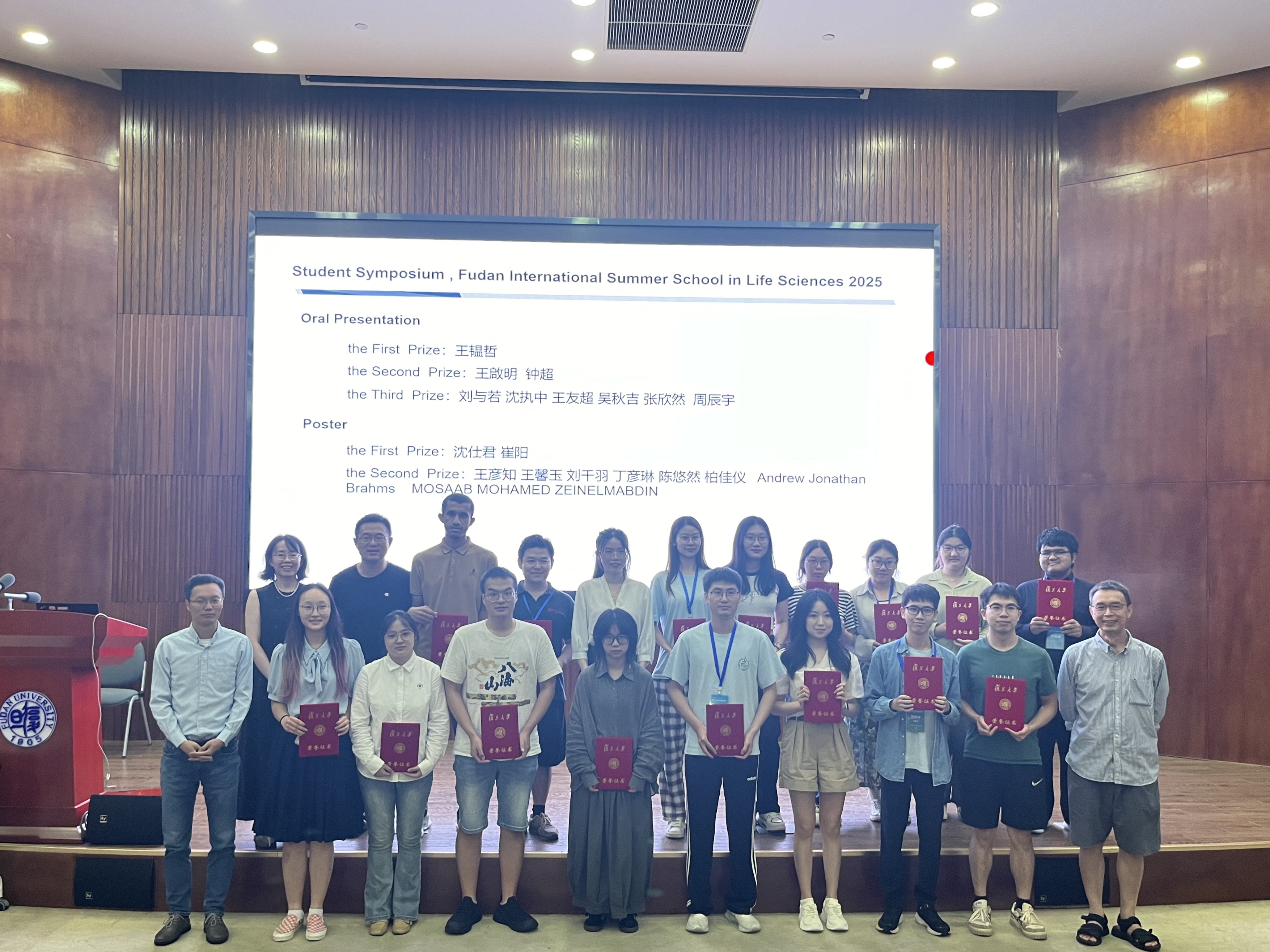
Time Morning Afternoon Agu 1 / Fri Li Jin & Shuhua Xu Manyuan Long & Yong Zhang Agu 2 / Sat Chung-I Wu Jian Yang Agu 3 / Sun Ting Wang Daofeng Li (workshop) Agu 4 / Mon Katrin Andreasson & Philip Beachy Daniel Falush Agu 5 / Tue Mark Stoneking Shuhua Xu Agu 6 / Wed Student presentation Student presentation
Thoughts
Notes link - Module 1 (in personal Notion - private)
Notes link - Module 2 (in personal Notion - private)
This was my first time attending an international summer school for graduates.
Initially, I was plagued by gastroenteritis triggered by anxiety. Pressure was from all directions:
I was constantly receiving messages from my supervisor making enquiries and pressing for updates;
I had to continue preparing for IELTS during my spare time;
I only have maximum one day to prepare for English oral presentations;
I needed to commute 40 kilometres daily;
Meanwhile, I also maintained focus and critical thinking during the summer school lectures.
This process continued until one day during module 2, when I suddenly collapsed completely from exhaustion, like a string that had been wound too tightly and snapped in an instant. In the days that followed, I paused my IELTS preparation and set aside the work my supervisor had been persistently pushing. I would simply lie down upon returning to my dormitory. Actually, would it have been better to cast all those concerns aside from the beginning, to more thoroughly enjoy this relatively pure academic exchange?
Despite such pressure, during this summer school, there were numerous lectures that brought me delightful surprises and inspiration. For instance, epigenetics, which I hadn’t been interested in previously but often had to handle in collaborative work. After attending several meticulously prepared lectures on epigenetics, I started to understand that the reason I found it uninteresting wasn’t because it was inherently dull, but because no one had ever properly guided me into that world. These lectures introduced epigenetics from basic knowledge to advanced research with detailed explanations. All that previously heavy and seemingly disconnected knowledge and experience appeared to reconnect and form a coherent network. Many times I left the lecture hall feeling as though my brain had been thoroughly washed by knowledge, with a tingling sensation. I absolutely love this feeling.
The two oral presentations were also tremendously rewarding. Not only did they make me suddenly realise that my academic English expression had reached a level I previously couldn’t have imagined, but they also provided me with invaluable advice:
During a break after my first presentation, the professor working on gut microbiome discussed with me about his scepticism regarding the definition of intratumour microbiome in my project, which is actually a very important question in the field. Unlike my supervisor’s defensive reaction to similar questions, I understood the thinking that even though some rigorous experimental evidence had proven the existence of intratumour microbiome, we still couldn’t make definitive conclusions in our own projects. I had had similar thoughts when I frequently raised questions about negative controls with my supervisor when I first took over the project. Others’ studies with validations are not sufficient to support the concept in our own research.
It was also this professor who used an open-ended question to reignite my thinking about ecological niches of microbes. Two years ago, I had considered niche migration as an excellent perspective, but at the time I lacked the data and model supporting further exploration, so I gradually forgot about it. With his reminder, standing on my current knowledge and experience, I suddenly realised it wasn’t actually that difficult. And after that day, I have been considering a new project based on this question.
After the second presentation, I also received criticism from a professor currently working on intratumour microbiome. Although her criticism was quite severe, it didn’t frighten me at all. During the tea break, we continued our discussion on one of the issues. I discovered that she had already attempted related experiments on a hypothesis I had thought of (but our laboratory lacked the conditions to verify), though the results were less than satisfactory. This also prompted me to reconsider whether there were other possible measures to address her question.
There was also a student engaged in microbial research who, during the tea break following my presentation, suggested a direction for future refinement of my project—one I had never previously considered but was indeed feasible. Since I wasn’t familiar with it, I asked if he had any recommended articles, and he patiently provided a literature list for me, for which I was truly grateful.
Additionally, I am very happy to validate a “principle” I always believed base on my intuition—”any knowledge from seemingly different fields can actually be integrated”. Just as I was pondering a technical challenge in my future project, I attended Prof. Daniel Falush’s lecture. Although his research direction seemed completely unrelated to mine, a particular diagram in his presentation was exactly what I was conceptualising! Different backgrounds and different sequencing methods, but the data itself could transcend all that, generalising to other fields through its data structure and characteristics. I enquired about the related algorithm, and it felt as though I had grasped the very straw I had been desperately seeking.
Even more fascinating was the shock brought by a novel yet reasonable perspective. Prof. Ting Wang mentioned transposon-derived tumour neoantigens in his lecture, and I asked a related question. During our discussion, after he picked up on my point, he said he was particularly grateful I had raised this question, as it triggered a thought:
| If tumours expressed these neoantigens from the beginning, why didn’t T cells kill the tumours initially? |
| Could these neoantigens themselves actually cause chronic inflammation and lead to T cell exhaustion? |
I found this idea absolutely refreshing when I heard it! The concept of neoantigens had been proposed for quite some time, and everyone regarded them as something that activated immunity to fight against tumours. I had naturally accepted this view as well. However, when Prof. Ting Wang reconsidered the entire process, he detached himself from this established, presumptive hypothesis and stepped back to see more possibilities. The charm emanating from such thinking made me want to applaud immediately upon hearing it. I truly hope I can be like him, always stepping back to re-examine a concept or a hypothesis, regardless of how many people support it.
There were also some rather amusing incidents. For example, Prof. Cleveland, who studies adult neuronal regeneration, felt very much like Sheldon from The Big Bang Theory when giving his lecture—having his own unique understanding of academic theories and being extraordinarily persistent about them, even when some views might not align with mainstream opinions in the field. I asked a question about whether generating new neurons in the hippocampus in their experiments might have some impact on animal behaviour (the hippocampus affects memory, so a rough estimate would be that new neurons growing in the hippocampus might improve memory?). His first reaction was to ask me,
| Do you really believe in those animal behavioural experiments nowadays? |
I laughed at the time, because I remembered that before starting my postgraduate studies, I wanted to do some research on neuroscience. Therefore, during my first year, I took many neuroscience courses, including some literature seminars. However, when choosing my own project, I ultimately avoided a project related to depression that I could have selected, precisely because those behavioural modelling approaches were very anthropocentric and subjective. In my mind, they couldn’t truly represent corresponding psychological or mental issues. I really felt as though I had betrayed myself by asking that question.
Another example is Prof. Bing Zhu. His experimental designs were filled with ingenuity. And he often mentioned how each clever idea was born and what thoughts his students provided during the process. Hearing about his experience of working hard with students to think about and practice an idea, I felt that this is a true teacher who respects students. This is in stark contrast to the situation in China where the vast majority of teachers regard themselves as bosses or superiors.
Overall, this felt like an academic sanctuary where breadth exceeded depth. But because of its breadth, it liberated me from the oppressive routine of day after day intensely focusing on one particular area. Go to the wider world, learn more diverse knowledge, and never work behind closed doors or rest on one’s laurels.