Notes in seminar—16th national conference on gene function and expression regulation
Seminar information
Location: Xiamen, China
Time duration: 03 Dec 2025 - 05 Dec 2025
Pamphlet:
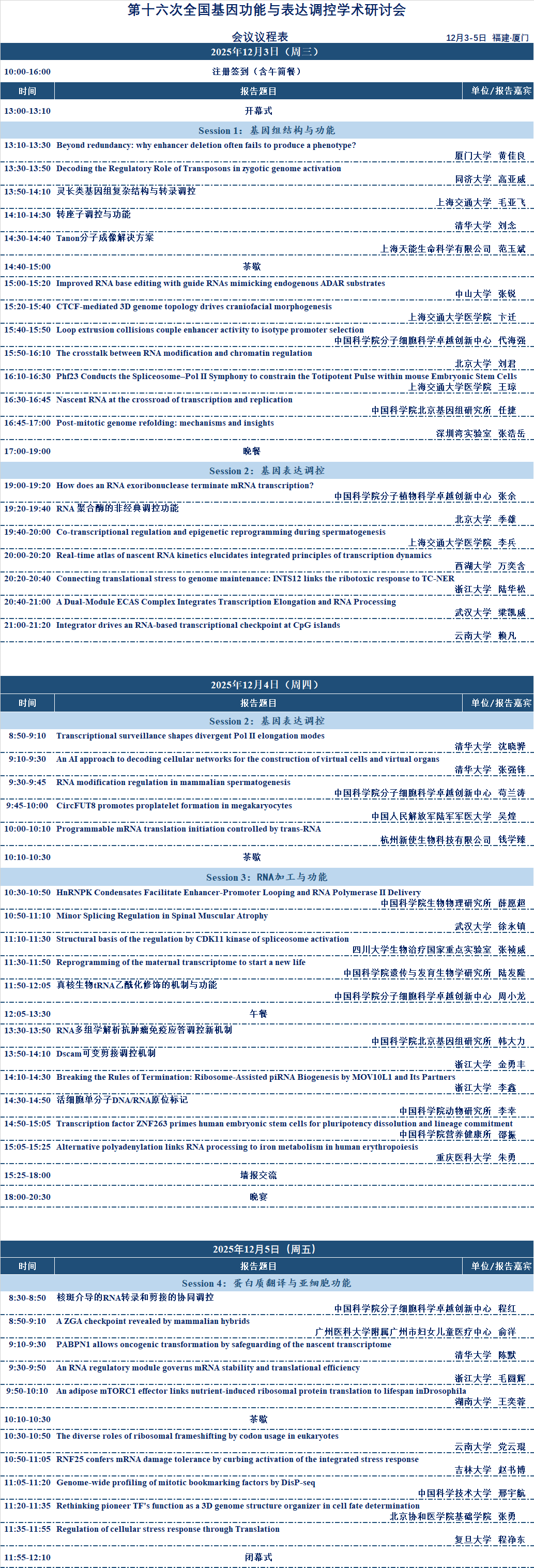
Thoughts
Notes link (in personal Notion - private)
This was the first time I antended a self-funded academic conference. I’d received a scholarship, and I thought to myself: This is exactly what scholarship money should be used for. But what struck me most wasn’t the financial sacrifice, it was the intellectual atmosphere I encountered there.
Speaker after speaker took the stage with no fanfare, no lengthy recitation of titles or honours, no elaborate introductions. Just a simple: “Next, Dr. So-and-so from Such-and-such Institution will present their research on this topic.” That was it. During the Q&A sessions, there were no flowery compliments, no superficial questions asked merely for the sake of asking. Every question was sharp, professional, deeply considered. It felt like stepping into an academic utopia—pure, clean, and focused entirely on the ideas themselves. In all my previous conference experiences, I’d never encountered anything quite like it.
This was also my first time attending a conference so intensively focused on molecular biology. Now, I’ve been studying in a biochemistry and molecular biology department for years, but truthfully, I hadn’t engaged systematically with foundational molecular biology in quite some time. Fortunately, during my first year of postgraduate study, I’d spent an entire year tutoring students preparing for entrance exams—essentially earning money whilst simultaneously revising the fundamentals. So the knowledge wasn’t entirely lost. Yet throughout listenning the presentations, I kept noticing gaps in my understanding due to concepts that remained frustratingly hazy. It wasn’t until other attendees asked questions that I suddenly realised: my shaky foundations were preventing me from connecting crucial dots between different pieces of knowledge.
And this brings me to something I need to think about seriously.
In our current moment, with AI tools becoming ubiquitous, there’s a growing sentiment that memorising knowledge is pointless. “Why bother learning it when AI can recall it instantly?” one of my fellows asked months before. But my conference experience revealed a critical flaw in this thinking.
If I rely entirely on AI for memory, I lose something irreplaceable: the ability to make connections in real time. When I’m sitting in a seminar, listening to a speaker describe their findings, my mind needs to be able to spontaneously link what I’m hearing to other concepts I know. If that knowledge isn’t already embedded in my mind, that moment of potential insight will simply passes me by. I cannot go back after the conference, review my notes, and somehow recover those connections. That would be like marking the side of a moving boat to find where I dropped the sword in the river. The moment has moved on.
Many potential connections, many threads in the network of knowledge, are simply invisible to us if I lack the foundational understanding at the precise moment I need it. I don’t even recognise what I’m missing.
This is what I, as a future (?) scientific researcher in this AI-saturated age, must remain vigilant about. AI is a powerful tool, but it cannot replace the integrated knowledge that allows us to think critically and spontaneously in the moment. Deep understanding isn’t just about accessing information; it’s about having it ready and structured in my mind when I need it most.